

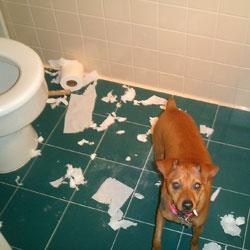
House training a dog presents multiple challenges
House Training vs. House Breaking
House training a dog is more than just potty training. It is teaching a dog how to act in the house. In addition to potty training, house training includes teaching your dog which chew toys are appropriate, rules about getting on the furniture, how to act when you are eating dinner, etc. Thus, your dog cannot be expected to automatically know what makes a good chew toy, that we want them to potty only outside, or any other house rules. It is our job to teach them.
House breaking implies punitive measures designed to “break” the dogs of bad habits. In the case of a puppy or an older dog that hasn’t been house trained, trying to break bad habits without teaching it what you want it to do is futile. Housebreaking is not necessary and will be detrimental to your relationship with your dog.
On this page, you will find several highly effective techniques and tips designed to make house training your dog as easy and low stress as possible. However, it will still take a lot of consistency, reinforcement, and repetition. As with any dog training, it will also take ample patience, but the payoff of a well-trained dog is well worth the effort.
-
Tip: Patience is the key
Remember that when you train a dog, your dog doesn’t understand what it is supposed to do until you teach it. Have patience. Remember: your dog probably knows a lot more English than you do Dog.
House Training: Your Experiences
What experiences have you had with house training a dog?
[poll id=”2″]
Three Steps to Dog Training
Patience is the key
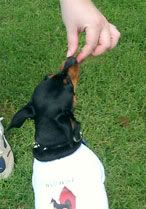
Reward your dog for doing well.
All dog training should rely on 3 steps: consistency, reinforcement, and repetition. While this takes a great deal of patience, putting these steps into practice will result in a well trained dog.
- Consistency: In the case of house training a puppy, consistency takes the form of supervision. You cannot consistently teach your puppy to go outside unless you can redirect it outside every time it starts to potty in the wrong spot and give a reward for pottying in the correct spot. This requires constant supervision whenever the puppy is allowed to roam free in the house. Thus, if you are unable to watch the puppy constantly, use short- and long-term confinement areas (discussed below).
- Reinforcement: This is how you let your puppy know when it has done the right or wrong thing. Positive reinforcement (treat and praise) should be used every time. Negative reinforcement, saying “no” in a deep, gruff voice, may also be helpful, but one shouldn’t scream, yell, or be overly harsh with the puppy. You don’t want your puppy to fear you. One should NEVER rub the puppy’s nose in “it.” It is counterproductive and mean.
- Repetition: Dogs instinctively like to potty in the same spot, and so in the context of potty training, repetition is even more important than in other training situations. Take your puppy to the same spot in the yard every time.
Never ask more of your dog than it is physically able to do.
It’s frustrating for you and the dog.
Confinement Areas
Short term and long term
You want to set your dog up for success, and to do that, you must not ask more of your puppy that it is physically capable of doing. This is where large and small confinement areas come into play. Here is the set-up: A crate or cage (short-term confinement area) is put inside the larger play pen or fence (long term confinement area).
The puppy needs a small confinement area where elimination is not allowed. The puppy will most likely avoid going in the smaller area instinctively. The larger area should be lined with “Piddle Pads,” newspapers, or other absorbent material. This is where the puppy can go to to the toilet. Expect the pads or newspapers to be shredded, though. When this happens, just replace the papers.
Watch the following video for more information.
Fact: Puppies can hold their bladder about 1 hour per month of age.
House Training Other Than Potty Training
Teaching your puppy how to act in the house
- Appropriate chews: Puppies will chew. If we don’t teach the puppy what is appropriate to chew, it will find something on its own (e.g., a roll of toilet paper is great fun to a puppy). Redirection (see “Tips and Techniques,” below) is a powerful tool to teach appropriate chewing.
- Where to lie: Some dog owners are very strict about where their dog lies, and only allow it to lie in its designated area. Others are more lenient and allow the dog on some furniture. Whatever rule you want to set, now is the time to do it. Keep in mind the size of your full grown dog when you do this. For example, if you have a Great Dane and allow it in bed with you, once it’s full grown, you might end up on the floor unexpectedly some night.
- Dinner time: You also need to decide how you want your dog to act at dinner time–yours and theirs. Dogs are capable of containing themselves around food, no matter what they might lead you to believe. My dogs are required to lie down and stay before they get their food. They can only eat after the release command is given. This leads to acceptable (though not always perfect) behavior. At our dinner time, the dogs are ignored. If they are too intrusive, they must leave the room. Never feed a dog from the table. That look of hopefulness is actually a dominance stare.
-
Tip: Teaching Moments
Just as any good teacher will tell you, the best teaching moments are often unplanned. Be aware and work training into your everyday routine when you can.
Chew Toys Are Essential
House Training Tips and Techniques
- Redirection: Redirection is especially useful to teach which objects are chew toys and which are not. In this technique, when the puppy is chewing something inappropriate, the object is taken away, and “no” is said gruffly and in a low-pitched voice. Then, a chew toy is given to the puppy and “chew this” or something to that effect is said in a high-pitched, sweet voice. This technique works well because puppies are usually happy to chew on anything in front of them.
- Tethering: Tethering is a technique that helps in the supervision part of training a puppy. A lightweight leash is attached to the puppy’s collar and the other end is attached to you (on a belt, for example). This way, the puppy cannot wander too far without you knowing about it. Since a high degree of supervision is necessary for house training, this technique can be very useful.
Use Punishment Sparingly
Only use negative reinforcement if the dog knows it has broken a rule. It is unfair and counterproductive to punish a dog when the dog doesn’t know why it is being punished.
- Time outs: With some dogs, time outs can be very useful. When the puppy understands that it is not supposed to do something but does it anyway, time outs are appropriate. This works just like it does with kids. Confine the puppy and then make it stay for a prescribed amount of time. This works well with Zeus, my older miniature pinscher. He puts himself in time out when he gets caught; it doesn’t work with my younger dog, Athena, though. She is happy and proud of whatever she does. Note: some dog trainers will tell you that you should never use a dog’s carrier (safe place) for punishment. This may be true with some dogs, but in my experience, using their carrier for time outs has been useful. It is like sending a child to his or her room. Do what works for you and your dog.
- Water pistol: With Athena, a water pistol is effective negative reinforcement. It provides instant results.
Are you the leader of your pack?
What are your experiences with dog training? Have you tried any techniques like these? Do you have others you would like to share? Tell us about your experiences.


7 pings
Skip to comment form ↓
Puppy Housebreaking Tips | Train Your Puppy
September 3, 2013 at 7:22 pm (UTC 0) Link to this comment
[…] How to House Train Your Dog » MinPinMania http://minpinmania.org/Consistency: In the case of house training a puppy, consistency takes the form of supervision. You cannot consistently teach your puppy to go outside unless you can redirect it outside every time it starts to potty in the wrong … […]